

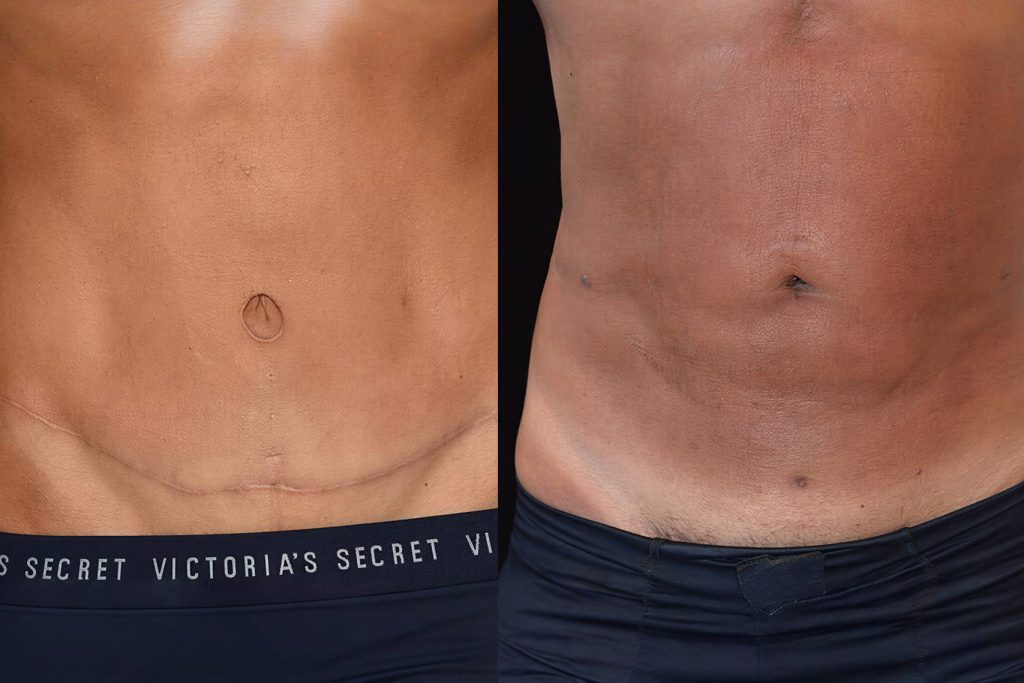
It’s the most common question I hear during consultations: ‘Do I need a tummy tuck or liposuction?’ Often, patients come in convinced they know the answer, only to discover they’ve been thinking about it wrong.
Here’s the fundamental truth that most people don’t understand: liposuction and tummy tucks solve completely different problems. Liposuction removes fat. A tummy tuck removes skin, tightens muscle, and may include some fat removal. Choosing between them isn’t about which one is ‘better’ — it’s about understanding which problem you actually have.
This guide will help you understand the difference, assess your own situation, and have a more informed conversation with your surgeon. While only an in-person consultation can give you a definitive answer, this information will help you understand why your surgeon recommends what they recommend.
The Fundamental Difference
Let’s start with what each procedure actually does.
Liposuction: Fat Removal Only
Liposuction removes fat cells from specific areas of your body. A surgeon inserts a thin tube called a cannula through small incisions, then uses suction to remove unwanted fat deposits. Modern techniques like Vaser use ultrasound energy to break up fat cells before removal, allowing for more precise sculpting.
What liposuction can do: Remove stubborn fat deposits that don’t respond to diet and exercise. Sculpt and contour specific areas. Reduce volume in targeted zones. Provide fat for transfer to other areas like the buttocks in a BBL.
What liposuction cannot do: Tighten loose or sagging skin. Repair separated abdominal muscles. Remove stretch marks. Address significant skin excess.
Liposuction relies on your skin’s ability to contract and conform to your new smaller shape. If your skin has good elasticity, it will shrink to fit. If it doesn’t, you may end up with the same loose skin you had before, just with less fat underneath it.
Tummy Tuck: Skin, Muscle, and Fat
A tummy tuck — technically called abdominoplasty — is a more comprehensive procedure. It involves removing excess skin from the abdominal area, tightening the underlying abdominal muscles if they’ve separated, repositioning the belly button, and often includes some liposuction for contouring.
What a tummy tuck can do: Remove loose, hanging skin. Repair diastasis recti, which is the separation of abdominal muscles that often occurs after pregnancy. Eliminate stretch marks that are on the removed skin. Create a flatter, tighter abdominal profile. Address both skin excess and fat in one procedure.
What a tummy tuck involves: A longer incision, typically hip to hip, which results in a permanent scar. More extensive surgery with longer recovery time. Higher cost than liposuction alone.
How to Assess Your Own Situation
While a surgeon’s evaluation is essential, you can get a preliminary sense of which procedure might be appropriate for you.
The Pinch Test
Stand in front of a mirror and pinch the skin on your lower abdomen. What do you feel?
If you pinch and feel a thick layer of fat beneath the skin, liposuction may be appropriate. The fat is the problem, and removing it could give you the results you want — assuming your skin has good elasticity.
If you pinch and the skin feels thin, with little fat beneath it, the problem is likely excess skin, not excess fat. Liposuction won’t help because there’s not much fat to remove. You likely need a tummy tuck.
If you can pinch and pull the skin away from your body significantly, like a curtain, you have substantial skin laxity that only a tummy tuck can address.
The Skin Elasticity Assessment
Pinch the skin on the back of your hand and release it. Does it snap back immediately, or does it take a moment to settle? Now compare that to your abdominal skin.
Skin that snaps back quickly has good elasticity and may respond well to liposuction alone. Skin that takes time to settle, or that shows visible creasing or sagging, has lost elasticity. Removing fat from beneath it will likely leave you with loose, deflated-looking skin.
Signs of Diastasis Recti
Diastasis recti is the separation of the rectus abdominis muscles — the ‘six-pack’ muscles that run down the front of your abdomen. This commonly occurs during pregnancy when the growing uterus pushes these muscles apart.
To check for diastasis recti, lie on your back with your knees bent. Place your fingers just above your belly button, pointing toward your feet. Lift your head and shoulders off the ground slightly, like you’re doing a small crunch. Feel for a gap between the muscles.
If you feel a gap of two finger-widths or more, you likely have diastasis recti. This muscle separation creates a characteristic ‘pooch’ that no amount of exercise or fat removal will fix. The muscles need to be surgically repaired, which is part of a tummy tuck.
Liposuction: A Closer Look
Let’s explore liposuction in more detail for those who may be good candidates.
Ideal Liposuction Candidates
The best candidates for liposuction are at or near their goal weight but have localized fat deposits that won’t budge despite diet and exercise. They have good skin elasticity, meaning their skin will contract after fat removal. They don’t have significant loose skin or muscle separation. They have realistic expectations about what the procedure can achieve.
Liposuction is not a weight loss procedure. It’s a contouring procedure for people who are already relatively fit but want to refine specific areas.
Common Liposuction Areas
For abdominal contouring, liposuction commonly targets the upper and lower abdomen, the flanks or love handles, and the back including bra rolls. When performed on someone with good skin quality, liposuction can create dramatic improvements in body contour.
Liposuction Recovery
Recovery from liposuction is generally faster than from a tummy tuck. Most patients return to desk work within one to two weeks. Swelling is significant initially but subsides over several weeks. Compression garments are worn for several weeks to help skin conform. Final results are visible at three to six months. Full exercise can typically resume at four to six weeks.
Tummy Tuck: A Closer Look
For those whose concerns go beyond fat deposits, here’s what a tummy tuck involves.
Types of Tummy Tucks
A mini tummy tuck addresses the area below the belly button only. It involves a shorter incision, less skin removal, and typically no muscle repair. It’s appropriate for patients with limited skin excess confined to the lower abdomen.
A full tummy tuck addresses the entire abdominal area from ribs to pubic bone. It involves a longer hip-to-hip incision, belly button repositioning, muscle repair if needed, and removal of significant skin. This is the most common type and addresses the most concerns.
An extended tummy tuck goes beyond the standard procedure to address the flanks and sometimes the lower back. It’s appropriate for patients with excess skin that wraps around to the sides, often after massive weight loss.
Ideal Tummy Tuck Candidates
The best candidates have loose, sagging abdominal skin that won’t improve with diet or exercise. They may have diastasis recti or muscle separation. They may have stretch marks on the lower abdomen that would be removed with the excess skin. They are done having children, since pregnancy would compromise results. They are in good overall health and at a stable weight.
The Scar Tradeoff
Let’s be honest about scars. A tummy tuck leaves a permanent scar running from hip to hip, typically placed low enough to be hidden by underwear or a bikini bottom. The scar fades over time but never disappears completely.
For most patients, this tradeoff is worthwhile. They’d rather have a flat stomach with a scar than a saggy stomach without one. But if the idea of a permanent scar is unacceptable to you, a tummy tuck may not be the right choice.
Tummy Tuck Recovery
Recovery from a tummy tuck is more extensive than liposuction. The first week involves significant discomfort and limited mobility. Drains are typically in place for one to two weeks. Most patients return to desk work at two to three weeks. Compression garments are worn for six to eight weeks. Exercise restrictions last six to eight weeks. Final results are visible at six to twelve months as swelling fully resolves and scars mature.
Can You Combine Both Procedures?
Yes, and it’s very common. Many patients benefit from a tummy tuck that includes liposuction for additional contouring.
The combination makes sense when a patient needs skin removal but would also benefit from fat reduction in areas the tummy tuck doesn’t directly address, like the flanks or upper abdomen. The liposuction component allows for more refined sculpting beyond what skin removal alone achieves.
However, there are important safety considerations. Aggressive liposuction combined with a tummy tuck can compromise blood supply to the remaining skin, increasing risk of complications. A responsible surgeon limits the extent of liposuction performed simultaneously with a tummy tuck.
In some cases, the safest approach is staged procedures — a tummy tuck first, followed by liposuction several months later once everything has healed. This may require two recoveries, but it prioritizes safety.
Making Your Decision
Here’s a simplified framework for thinking about which procedure you might need.
Consider liposuction alone if you have good skin elasticity, your primary concern is localized fat deposits, you don’t have significant loose skin, and you don’t have muscle separation.
Consider a tummy tuck if you have loose, sagging skin, you have stretch marks you want removed, you have diastasis recti or muscle separation, you’ve had significant weight loss or pregnancy that left excess skin, and liposuction alone won’t address your concerns.
Consider combination procedures if you need a tummy tuck but would benefit from additional contouring and your surgeon confirms this can be done safely.
Conclusion
The choice between liposuction and a tummy tuck isn’t about which procedure is better — it’s about which procedure addresses your specific concerns. Fat without loose skin points toward liposuction. Loose skin with or without fat points toward a tummy tuck. Muscle separation requires a tummy tuck.
The only way to know for certain is a consultation with a qualified plastic surgeon who can examine you, assess your skin quality and muscle integrity, and recommend the procedure that will actually give you the results you want.
Come to your consultation informed, but come with an open mind. Sometimes what we think we need isn’t what will actually help us.